Why AI Needs Data Fabric, Metadata & Metrics Governance to Scale
Interview w/ Ritish Chugh
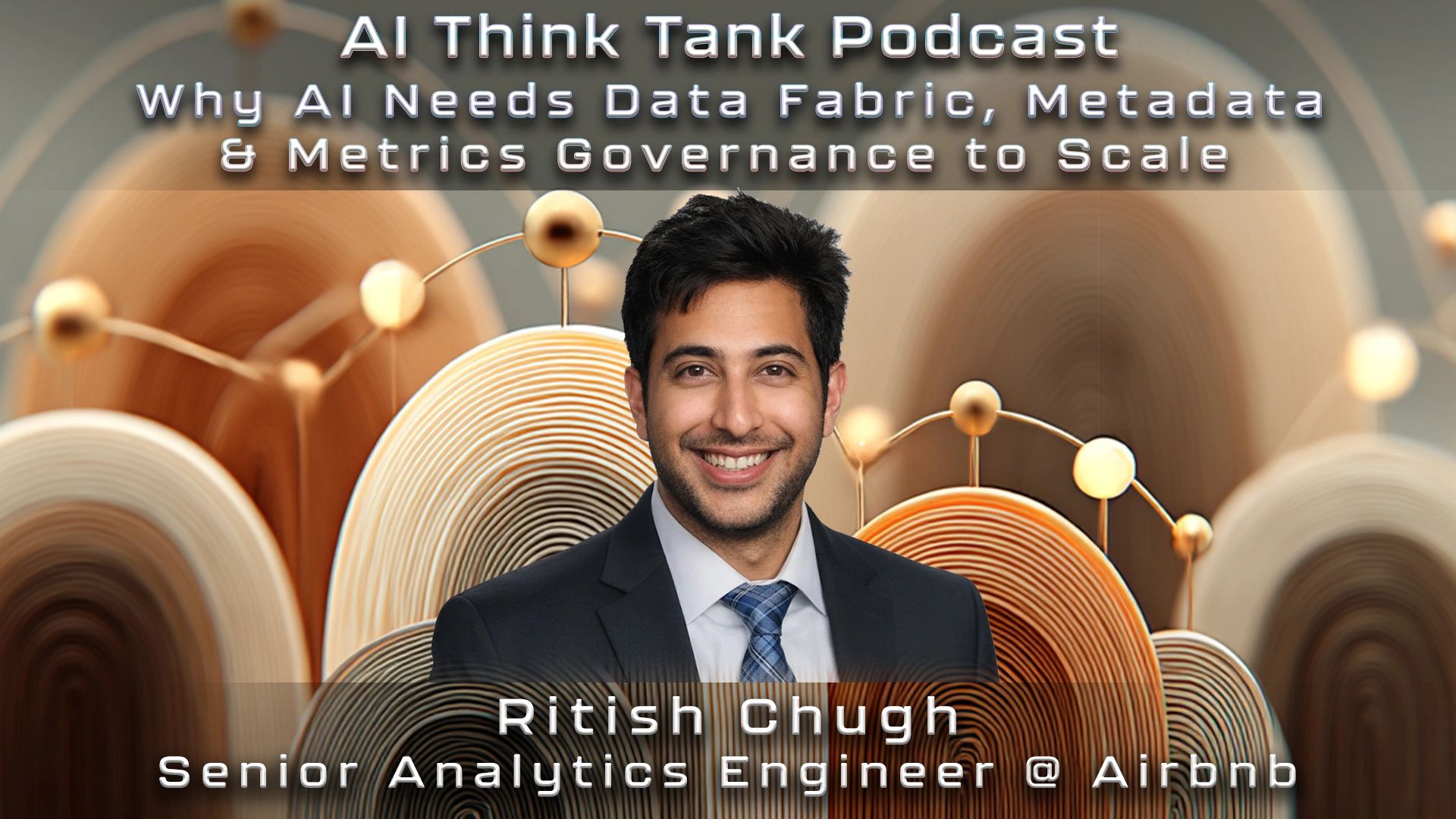
I do not often get to sit down with someone who operates at the intersection of financial data infrastructure, enterprise analytics, and AI readiness. Ritish Chugh is one of those rare people. He is a Senior Analytics Engineer, where he leads reporting and analytics for finance business users across 160 countries. Before that, he spent years at Amazon Prime Video managing end-to-end business metric reporting and KPI dashboards for third-party living room devices. Before that, he cut his teeth in fraud and risk analytics, managing portfolio strategies for nearly 1,000 banks and chasing down millions of dollars in fraud losses year over year.
Ritish grew up in New Delhi with a passion for math, physics, and electronics. He pursued an engineering degree focused on VLSI and chip design before pivoting into consulting, where he discovered what would become his life’s work: acting as a bridge between business stakeholders and engineering teams. That search for a discipline to formalize that bridge brought him to the University of Cincinnati, where he completed a master’s in what was then called mathematical computation and quantitative analytics. The field was so new that “data science” did not yet exist as a label for it. He has been building at that intersection ever since.
We recorded this conversation in February 2026, and I wanted to have him on because the topic he cares most about is one that I see being systematically ignored by companies racing to deploy AI. Everyone is talking about models and agents and interfaces. Very few people are talking about whether the data those systems run on is actually trustworthy.
The Missing Foundational Layer
Ritish opened with an observation that set the tone for our entire conversation. He acknowledged that companies are genuinely motivated to invest in AI, that they want productivity gains, faster product delivery, and better customer service outcomes. But he identified a critical gap in how most organizations are pursuing those goals.
“Investing in the right foundation is something that more and more companies are really not investing in at the moment,” he said. “What I mean by it is everything we do in data, using AI apps, is obviously based on the data. If your data is validated, if this data is accurate, no matter what tool you’re using, it’s going to be trustworthy.”
He is right, and I have seen this pattern repeatedly. Companies treat data quality as an engineering detail rather than a strategic prerequisite. They deploy dashboards, build AI assistants, and stand up agent systems. Then they wonder why adoption is sluggish or why executives keep asking the same uncomfortable question in every meeting: why do these numbers not tie together?
That question matters more than people realize. It is not just a reporting annoyance. It is a signal that the foundation is cracked.
Five Definitions of Revenue Is Four Too Many
One of the clearest moments in our conversation came when Ritish described what metric fragmentation actually looks like inside a large organization. It is not abstract. It shows up as a room full of people who cannot agree on what the company’s revenue number is.
“You cannot have five different definitions of revenue,” he explained. “Your marketing team looks at revenue in a different way. Your finance team looks at revenue in a different way. Then comes your sales team, which is recording revenue in a different way. That is the reason you need to have this metadata where essentially all teams share a single definition of all key business metrics.”
This is what he means by a semantic layer and unified metric governance. The goal is not simply to pick one formula and enforce it. The goal is to create a living, governed definition that every tool, every team, and every geography pulls from. When that layer exists and is properly maintained, a dashboard, a SQL query, and a conversational AI agent should all return the same number when they ask the same question.
He described working through the complexity of tax jurisdictions as one example of why this is harder than it sounds. France alone has roughly 20,000 tax jurisdictions. Getting data to behave consistently across that kind of complexity requires not just good engineering but genuine organizational alignment. Teams have to agree on definitions. They have to own the upstream and downstream data sets that feed those definitions. And every change has to go through a formal approval process with a traceable audit trail.
“You can always go back and refer to it,” he said. “Who changed it, when it got changed, why it got changed. You have an entire paper audit trail. Especially in a company that deals with a lot of regulators, it is extremely important to maintain that audit trail.”
The Semantic Layer as Infrastructure
Ritish spent considerable time explaining what the semantic layer actually is and why it needs to live inside the infrastructure rather than floating above it as a reporting configuration.
“Once the consensus is defined, once the key business metrics are defined, then comes the idea of this foundational glue, the semantic layer, which acts as a bridge between your data schemas and your business metrics,” he said. “It knows what data lies underneath. It knows what your metrics are and how you define them. Now it is just a matter of acting as a foundational glue between them that can speak the language.”
He stressed that this layer is not a tool you swap in and out. It is part of the infrastructure. It lives there. And once it is in place, it becomes the reason that every downstream application, from legacy dashboards to modern AI agents, can return consistent results.
“No matter what tool you are using after that,” he noted, “it is going to give you the same exact results.”
I found this framing genuinely useful, because it reframes the semantic layer from a business intelligence concept into a platform decision. You are not configuring a report. You are building a piece of infrastructure that every AI system you will ever deploy is going to depend on. Get it right once and everything built on top of it inherits that correctness. Get it wrong and you are propagating errors at scale.
Trust Is the Real Adoption Problem
Ritish was direct about why AI adoption stalls in so many organizations, and it is not the models. It is not the interfaces. It is not even the change management. It is trust.
“At the end of the day, it really comes down to, can I trust this data or not?” he said. “What kind of validation framework are you using to really validate this? And how far back does it go in terms of reconciling all this information together?”
He described sitting in meetings where executives were asking why AI adoption was not scaling, and the answer kept coming back to the same root cause. Leaders did not trust the data. If a VP of Finance is not confident that the number on the screen is correct, they are not going to use the system that produced it. No amount of model improvement or UI polish changes that calculus.
“It is such a fundamental integrity issue,” he said plainly.
I agreed, and I pushed a little further on this. “If you want trust,” I said during our conversation, “you have to engineer it first. You cannot build it last in a system. It is not an afterthought.”
That is a principle I come back to constantly. Trust in an AI system is not a perception problem. It is an architecture problem. You build it into the pipeline or you do not have it.

Human in the Loop Is Not a Temporary Measure
Ritish was thoughtful and measured when we got into the question of automation and human oversight. There is a lot of pressure in the industry to treat human review as a cost to be eliminated over time. He pushed back on that idea, at least for the environments he works in.
“I am a very strong proponent of human in the loop, which I can see should be there for the foreseeable future, because it is not completely hands off,” he said. “Especially in areas with a high amount of regulation, there is a requirement for human in the loop.”
This is not a conservative position. It is a realistic one. When you are managing financial data that feeds regulatory filings, the stakes of an error are asymmetric. A wrong number in a dashboard can be corrected. A wrong number in a quarterly financial statement filed with regulators is a different category of problem entirely.
The semantic layer and governance framework he described actually make human review more effective, not less necessary. When every change is logged, when ownership is clearly assigned, and when definitions are transparent and centralized, the humans in the loop have the context they need to catch problems early rather than discovering them after the fact.
What Is Actually Working
I asked Ritish what approaches he has seen generate real results, and he brought the conversation back to the theme he had been building toward the entire time.
“Going back to the idea of governance, where each organization and team does not operate in silos, they are actually able to synchronize on a common understanding of a fundamental metric. Now, it does not really happen that your numbers do not talk to each other. Everyone is on the same page when you talk about a certain metric because it is democratized.”
He described what becomes possible once that foundation is in place. Analysts in the United States, Singapore, and Australia pull the same metric and get the same result. Reconciliation exercises that used to consume weeks of engineering time disappear. And critically, the door opens to the kind of agentic AI systems that executives are asking about, because those systems finally have something trustworthy to reason over.
“Leaders are now asking for how they can really use conversational AI to really get to know about the data,” he said. “So this is the fundamental thing. We can use agents in natural language and get the same exact output, then spin up a dashboard, write queries, generate a report. The opportunities are endless.”
That last point matters. The payoff for doing the foundational work is not just cleaner reports. It is the ability to unlock every downstream use case that depends on reliable data. You are not just fixing a reporting problem. You are building the infrastructure that makes every future AI investment more valuable.
Building the Foundation Before the Roof
Ritish writes regularly on HackerNoon, where he has published extensively on conversational analytics and how the analytics landscape is shifting from traditional dashboards and SQL to natural language interfaces. His argument across those pieces mirrors what he shared on the show: the interface layer can only be as good as the data layer beneath it.
He closed our conversation with a clear and direct challenge to any organization that is currently investing in AI without first investing in data quality and metric governance.
“Data is actually a fundamental fuel of powering all these AI systems,” he said. “Without the right data foundation and without the right kind of governance, it is hard to move across boundaries and really create the trust and create adoption of these AI tools in society.”
I would add only this. Ritish is not describing a technical problem that only data engineers need to care about. He is describing an organizational maturity problem that shows up as a business performance problem. The companies that close that gap now are building leverage. The companies that skip it are building liability.
This is not mysterious work. It is not glamorous work. But it is the work that determines whether your AI investment returns value or returns frustration.
Ritish Chugh is one of the clearest voices I have encountered on this subject, and I am glad we got him on the show. He brings the kind of practiced, ground-level credibility that only comes from doing this at scale, in production, across real regulatory environments and real global operations.
🔗 Connect with Ritish Chugh https://www.linkedin.com/in/ritish-chugh/
📝 Read his work on HackerNoon https://hackernoon.com/conversational-analytics-the-next-generation-of-data-analysis-and-business-intelligence
Join us as we continue to explore the cutting-edge of AI and data science with leading experts in the field.
Subscribe to the AI Think Tank Podcast on YouTube. Would you like to join the show as a live attendee and interact with guests?
Contact Us