Building Better with Claude Agent Skills
With Co-host John McDonald
When I welcomed John McDonald back to the AI Think Tank Podcast, it had been about a year since his last appearance. In AI time, that gap might as well have been a decade. What unfolded during this conversation made that clear. We moved from early ideas around agents and protocols into a much more mature discussion about how agentic systems are actually being built today , and why Claude’s new concept of skills represents a genuine paradigm shift.
This episode, Building Better with Claude Agent Skills , was not just about new features or tooling. It was about a deeper realization that the future of agentic AI will be shaped less by monolithic agents and more by open, composable, human-readable procedural knowledge.
From MCP to Maturity
We began by grounding the discussion in Model Context Protocol (MCP), which Anthropic introduced in late 2024. When John and I first discussed MCP, it felt experimental. Today, it has become foundational.
“Protocols drive participation,” John said early in the conversation. “Once you have a protocol in place, you open the door for an entire ecosystem to form around it.”
That framing mattered. MCP was never just a technical connector. It was an industry signal. Within weeks of its release, other platforms adopted it, and the community began building MCP servers for everything from Docker to Slack. The upside was obvious. Agents could finally plug into real systems in a standardized way.
The downside appeared just as quickly. MCP servers became bloated. Context windows were consumed by tool definitions that were rarely used.
As I put it during the show, “You don’t need to read the entire recipe book when all you’re trying to cook is breakfast.”
Anthropic’s response, lazy loading MCP tools, was an important correction. It reflected a broader theme we kept returning to: progressive disclosure. Only load what the agent needs, when it needs it.
The Surprise of Claude Code
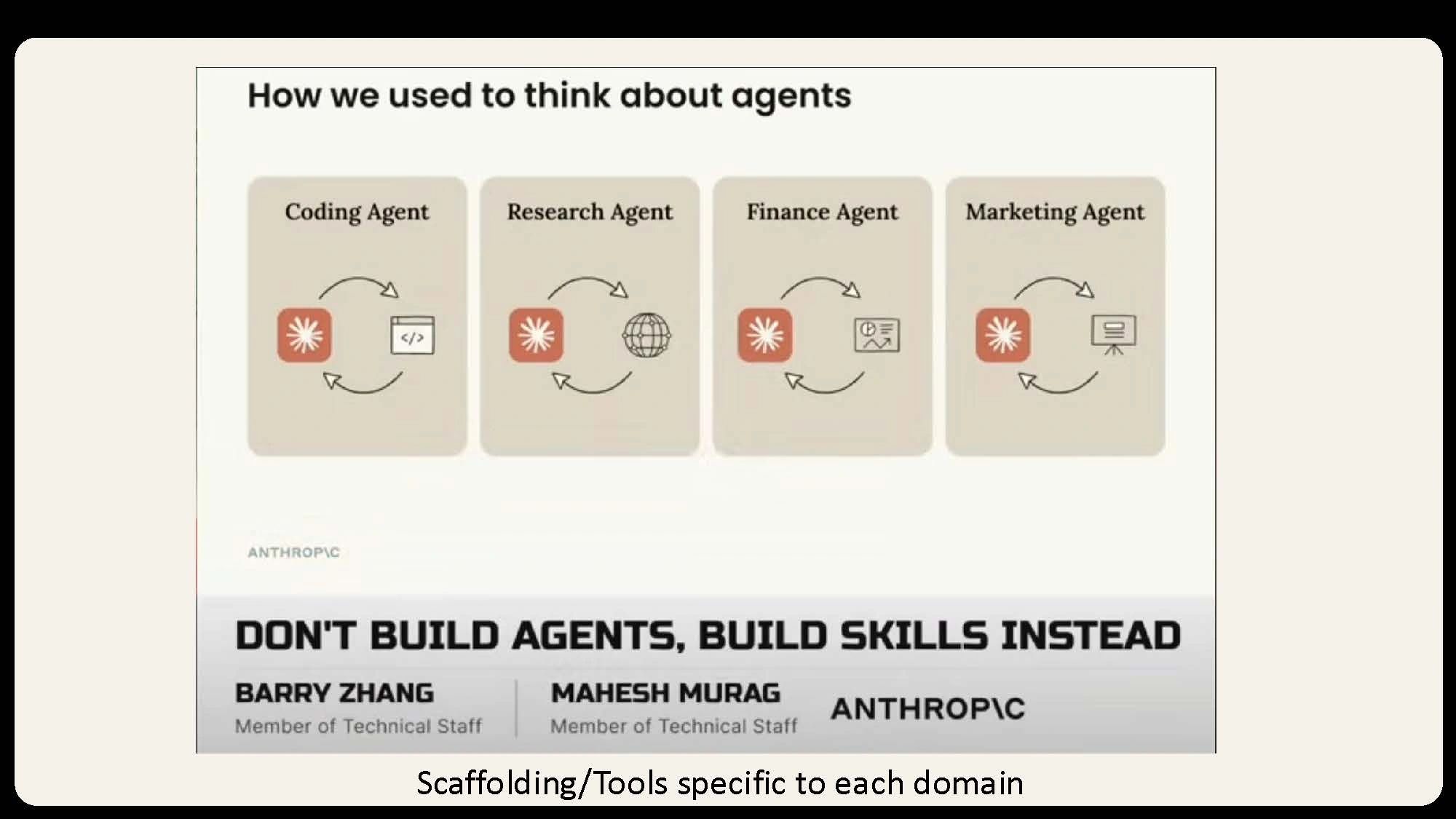
A major turning point in Anthropic’s thinking came from Claude Code itself. What started as a developer-focused coding agent quickly revealed something unexpected.
“They realized non-developers were using it,” John explained. “Marketing teams, finance teams, operations. It turned out to be far more general-purpose than they expected.”
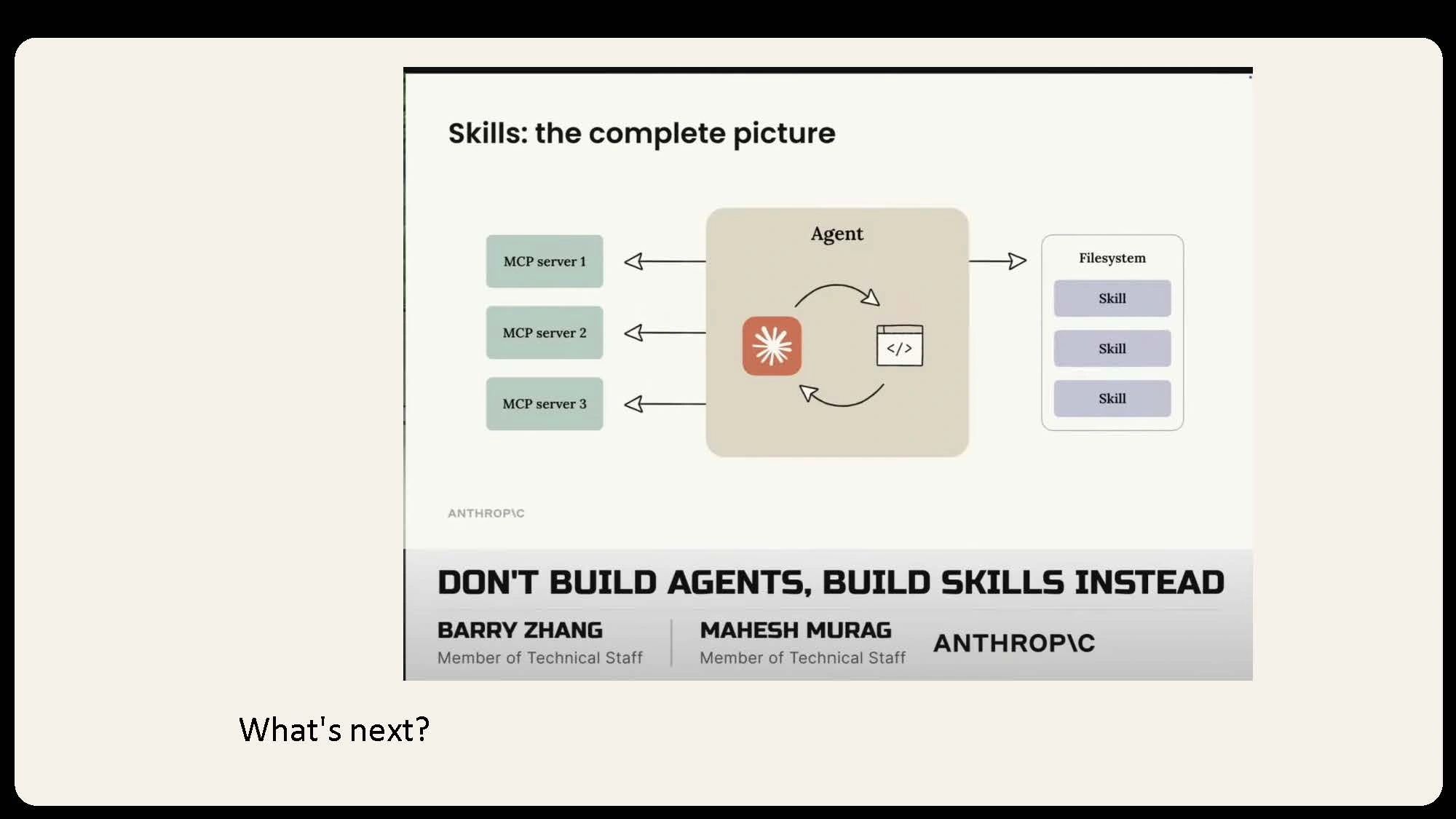
That discovery reframed everything. Instead of building countless vertical agents, Anthropic began asking a different question: What if the agent stays general, and the expertise lives elsewhere?
The answer became skills.
Skills as Procedural Knowledge
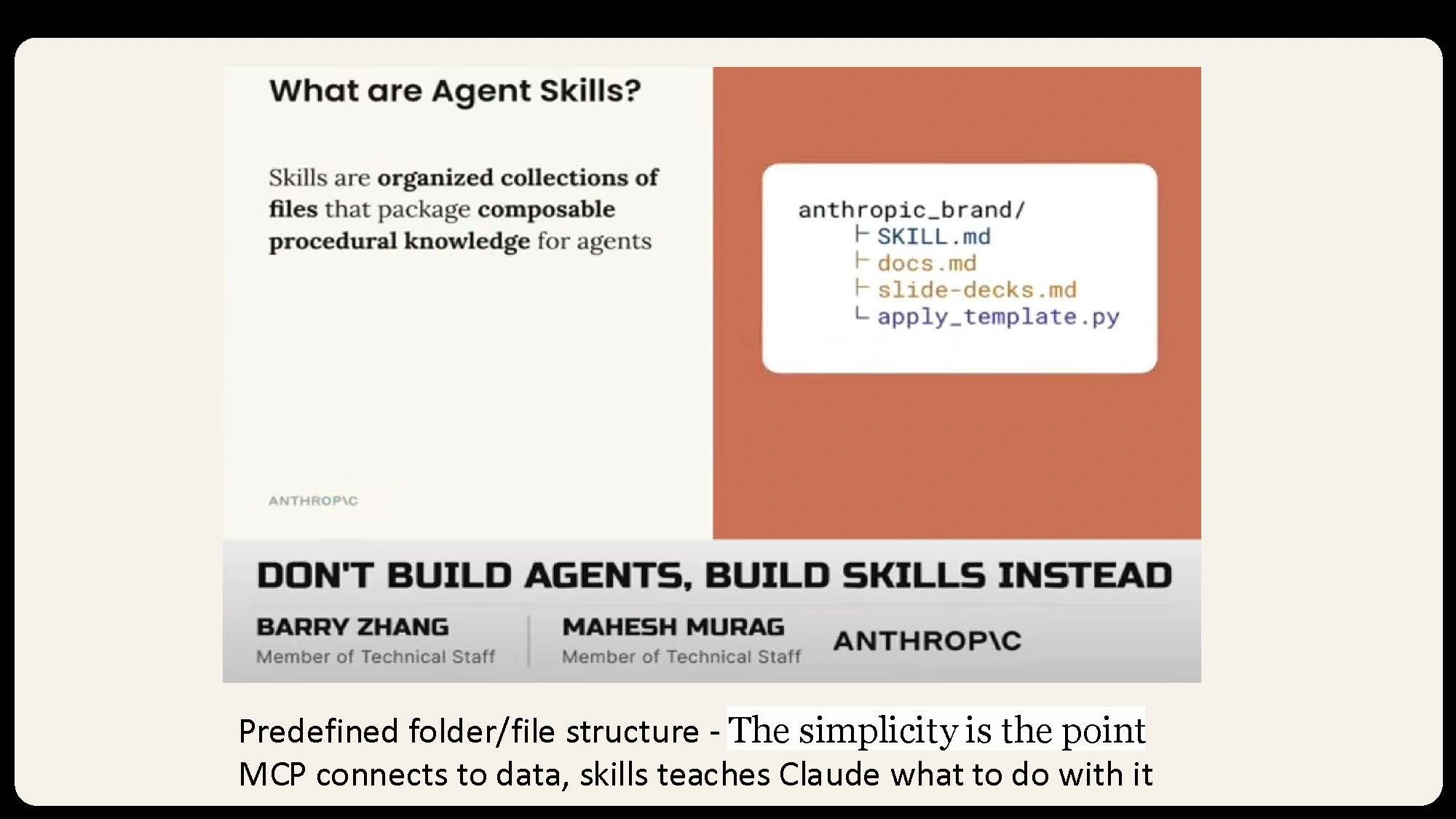
Claude skills are not magical. In fact, that is their strength. They are simply structured folders of files, Markdown documentation, examples, and executable scripts, that describe how something should be done.
“These skills are just files and folders,” John said. “We all know what files and folders are.”
That simplicity is deceptive. Because skills live in the file system, an agent can navigate them using basic shell commands. It can read instructions, load examples, execute Python scripts, and return real results. No guessing. No hallucinated workflows.
I emphasized this distinction on the show. “The generation part isn’t guessing. It’s interpreting intent and then executing real code. The results are calculated, not inferred.”
Skills move procedural knowledge out of the model and into a place where it can evolve safely. They can be versioned. Audited. Shared. Secured. Reused. And critically, they can be understood by humans.
An Open-Source Moment
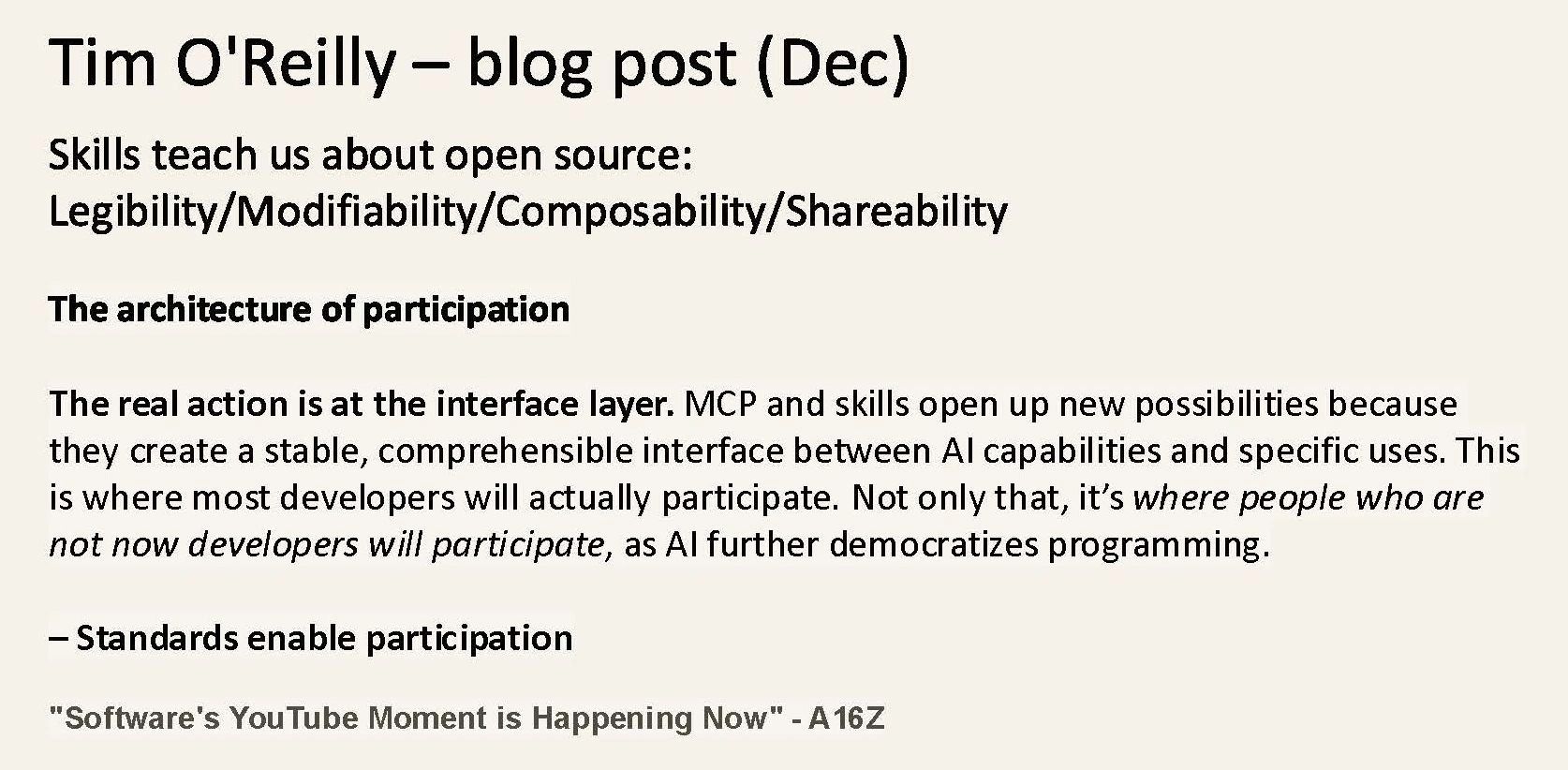
One of the most resonant moments in the episode came when John referenced Tim O’Reilly’s take on skills.
“He said this could be the ‘View Source’ moment for AI,” John explained. “Just like web developers could right-click and learn how a page was built, skills let you see how an agent actually does its work.”
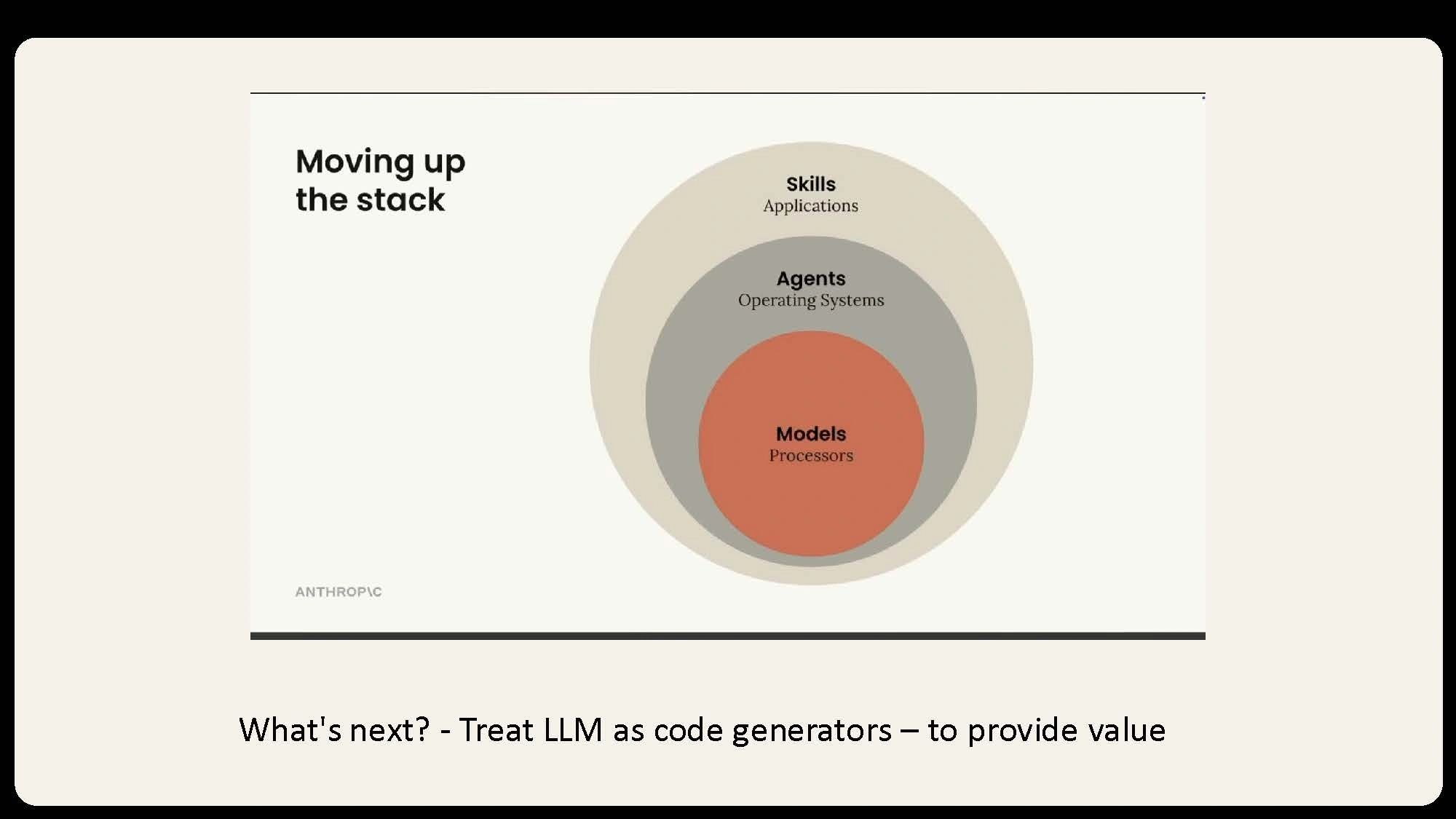
That comparison stuck with me. Skills sit at the application layer, not the model layer. They invite participation from subject-matter experts who may never fine-tune a model but deeply understand how work gets done.
As I said during the discussion, “This is beginner-approachable software development. It’s readable. It’s composable. It’s not locked in a walled garden.”
Enterprise Reality, Not Agent Hype
Much of our conversation focused on why this matters in the real world. Enterprises already have procedural knowledge scattered across documents, scripts, and tribal memory. Skills provide a way to formalize that knowledge without embedding it permanently into a model.
John demonstrated this with a practical example. He built a skill that automatically generated a project-status PowerPoint by analyzing files in a directory. The agent didn’t just write slides. It read documents, ran Python scripts, and produced a real artifact on disk.
“That’s something I do constantly as a product manager,” he said. “This saved real time.”
This is where skills shine. They handle the unglamorous, repeatable work that consumes human attention. They also respect enterprise constraints around governance, access control, and security.
Agents, but Grounded
Throughout the episode, I kept returning to a central idea: frameworks matter more than raw model power.
“The framework is often more powerful than the model,” I said. “Good structure beats bigger context windows.”
Skills reinforce that philosophy. They encourage modularity. They discourage reinvention. They make agent systems observable rather than mysterious.
As John summarized near the end, “We’ve been writing the same connectors and the same procedures over and over again. Skills are a way to stop doing that.”
Looking Forward
We closed by zooming out. Agent-to-agent communication, commerce protocols, wallets, security, and governance are all coming fast. Communities like agntcy.org and projects like MIT’s Project NANDA are working to ensure this future is built on open standards rather than closed silos.
“This feels like the early web again,” I said near the end of the show. “Open standards. Shared protocols. A community figuring it out together.”
John agreed. “In some ways it’s brand new. In other ways, there’s nothing new under the sun. We know how to build systems like this.”
That may be the most important takeaway. Claude skills are not a gimmick. They are a return to good system design, applied to a new class of intelligent tools.
Watch the full episode of AI Think Tank Podcast – Building Better with Claude Agent Skills and explore the discussion in depth.
Join us as we continue to explore the cutting-edge of AI and data science with leading experts in the field.
Subscribe to the AI Think Tank Podcast on YouTube. Contact Us